


For years the Erie Canal Harbor Development Corporation (ECHDC) has intended to construct a vaguely defined “children’s museum” concept on a prime parcel along the newly constructed canal-scape that now comprises the former Aud block. Explore & More, an East Aurora based firm, is designated to operate the venue.
The concept is a less-than-inspired effort to attract families to Downtown Buffalo, mainly from within a day’s drive. It hasn’t been sufficiently evolved and could be better sited. The Canalside district should be more focused on building out entertainment and dinning venues.
A better location would be just behind the First Niagara Center, where the NFTA-owns a structure that was formerly part of the DL&W Terminal. Developers and preservations have long pointed to the Terminal, which sits tightly along the Buffalo River in the Cobblestone District, as a prime redevelopment opportunity slightly removed from the former Aud block.

Planners and activists have been demanding a better concept that would serve as a more effective anchor-attraction. This publication is advancing the concept of a public-private partnership with General Mills, which sits directly across the river. The plant produces the firm’s iconic Cheerios cereal.
In broad strokes, the business concept is in three parts:
- Amusement exhibits built around General Mills’ brands
- Interactive programing and tours of the production plant and grain elevators
- Retail and site exclusive merchandizing
Imagine traveling from a Lucky Charms’ amusement space to a Fruit Loops world, while passing by characters like Count Chocula, Captain Crunch, Tony the Tiger, and the Pillsbury Doughboy.
The Cheerios Children’s Museum could also tell the history of cereal — which is the history of the grain industry, and therefore the history of Buffalo and our striking grain elevators.
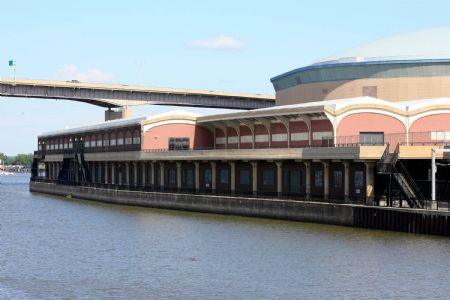
Of course, General Mills would have to consent to allowing its brands to be used to theme the children’s museum — but if state funds construct the visitors center at the DL&W Terminal or on the General Mills complex, then a public private partnership could be possible. With property, plant, and equipment costs absorbed by the state, the visitors center could easily generate a (potentially lucrative) operative profit.
The DL&W Terminal’s second level (which is empty) is 80,000 square feet and the first level (which is currently used as an NFTA train shed) is over 100,000 square feet. The Terminal also has an outdoor train lot at the crux of Michigan Street and the Buffalo River, which could accommodate additional development or active public space.
The planned structure for the children’s museum is being planned, but that 30,000 sq ft space can easily house restaurants, entertainment, or retail establishments — which are far more suitable for such a central pedestrian oriented streetscape.
